










posted 26th December 2025
The code that is hardwired, if you truly belong to it
Bushidō: Discipline as the Architecture of Life
The Bushidō code did not emerge as a romantic philosophy of warriors, nor as a ceremonial relic of a vanished Japan. It arose as a civilisational operating system - a framework through which individuals were trained to govern themselves before presuming to govern others. At its core, Bushidō is not about violence. It is about discipline, and discipline is the rarest currency in any age.
Bushidō demanded absolute alignment between thought, action, and consequence. The samurai was required to cultivate restraint equal to ferocity, humility equal to authority, and clarity equal to power. In this sense, Bushidō belongs not to Japan alone, but to all societies that seek durability rather than decadence.
The Samurai Archetype
The great samurai figures - Miyamoto Musashi foremost among them - were not merely tacticians of combat, but architects of inner order. Musashi’s legacy is often reduced to swordsmanship, yet his enduring contribution lies in his insistence that victory begins before conflict. In The Book of Five Rings, he articulates a principle that transcends war: mastery of one discipline illuminates all others. To fail in conduct is to fail in strategy.
Likewise, figures such as Takeda Shingen and Uesugi Kenshin exemplified Bushidō not through brutality, but through self-command. Their reputations endured because their inner discipline outlasted their military campaigns. Where others sought dominance, they sought order.
Discipline as a Universal Law
Bushidō insists upon a truth modern civilisation frequently resists: freedom without discipline collapses into chaos. The samurai understood that emotion, ego, and indulgence are liabilities. Precision of conduct-daily, habitual, uncompromising -was non-negotiable.
This is why Bushidō remains applicable to all aspects of life:
In scholarship, discipline preserves truth against distraction.
In leadership, discipline prevents corruption of authority.
In wealth, discipline distinguishes stewardship from excess.
In science, discipline separates inquiry from speculation.
In personal conduct, discipline transforms potential into legacy.
Bushidō does not ask whether a task is pleasant. It asks whether it is necessary.
The Mask and the Code
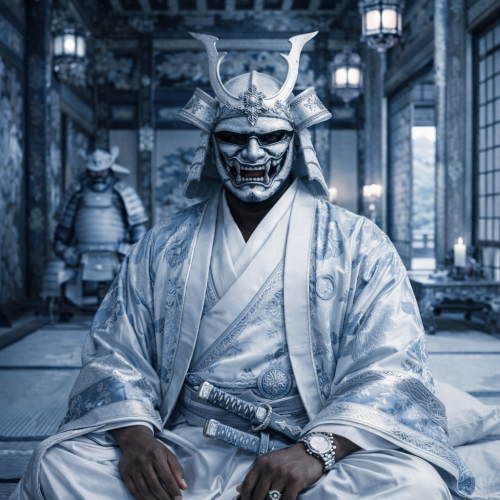
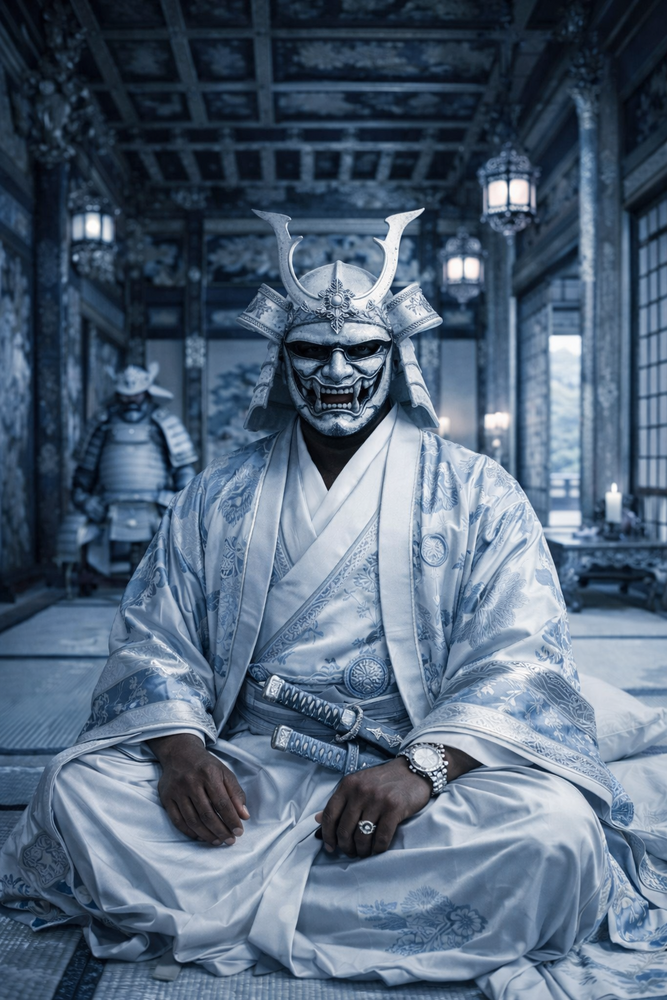
The samurai often concealed the face behind a mask-not to intimidate, but to erase the self. Identity was subordinate to duty. This principle stands in direct opposition to contemporary cultures of exhibition and validation. Bushidō teaches that the individual is temporary; the code is permanent.
In this way, Bushidō aligns with the ethos of institutions rather than personalities. It is not concerned with applause, but with continuity.
Relevance to the Modern World
Modern civilisation possesses unprecedented knowledge, yet suffers from a deficit of discipline. Bushidō offers no shortcuts and no comforts. It demands:
punctuality of action,
economy of speech,
honour in private as well as public,
and the courage to endure solitude when principles require it.
These are not antiquated virtues. They are foundational technologies of human excellence.
Conclusion
Bushidō is not a Japanese curiosity. It is a manual for human calibration. Musashi and the great samurai did not seek immortality through conquest, but through conduct. Their lesson is unequivocal:
Without discipline, talent decays. Without code, power corrupts. Without restraint, civilisation fractures.
To live by Bushidō is to accept that every action is a training ground, every moment a test, and every life a silent declaration of values.
This is not the way of the sword alone.
It is the way of life.