



posted 11th December 2025
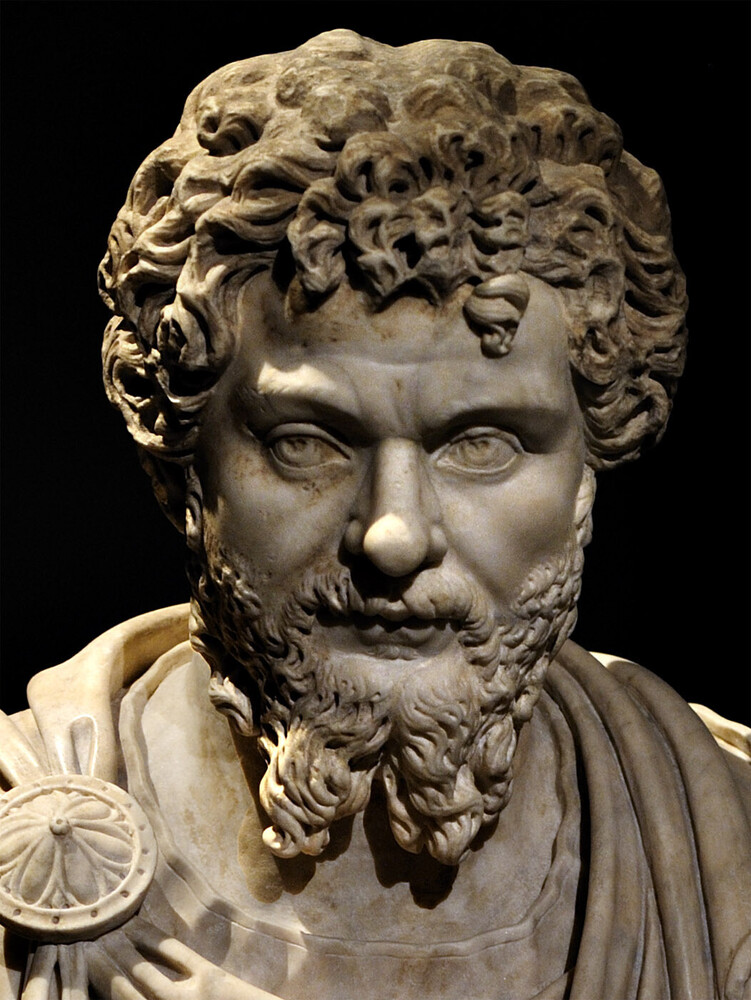
Septimius Severus (THE SEVENTH SERVANT)
SEPTIMIUS SEVERUS: THE BLACK EMPEROR WHO SAVED BRITAIN AND REWIRED THE DESTINY OF EMPIRE
A Sovereign Essay for the Institute of Black Nobility
There exist figures in history whose lives are not merely recorded—they are engraved into the foundations of civilization. Septimius Severus is one such figure: a man born in the warmth of North Africa who died in the cold winds of northern Britain, an emperor whose authority reshaped Rome, an African sovereign whose decisions still echo through British soil today.
He is remembered by historians, referenced by scholars, and occasionally mentioned in footnotes of empire. But the true magnitude of his legacy—its cultural, geopolitical, philosophical and civilizational weight—remains profoundly underappreciated. His life is not simply a biographical note in imperial Rome; it is a mirror of global identity, a challenge to racial mythology, and a testament to the intellectual and strategic agency of Africa within world history.
This is the Severus rarely discussed:
the emperor whose rule preserved Britain, expanded the Roman frontier, stabilised the empire, and demonstrated that African leadership at the highest tier of global power is not an anomaly—but an historical precedent.
I. THE AFRICAN ORIGINS OF AN IMPERIAL MIND
Septimius Severus was born in 145 CE in Leptis Magna, one of the greatest African cities of the Roman world. Unlike the simplistic interpretations forced upon antiquity by later periods, Rome at that time was a culturally porous empire—a multi-ethnic engine of conquest, commerce and intellect.
But Severus’ Africa was not a passive province.
It was:
A centre of wealth
A hub of grain production
A region rich in traders, scholars and military officers
A nexus where Berber, Punic and Mediterranean cultures blended
From this environment, Severus absorbed what many emperors lacked:
a cross-civilizational literacy, an ability to navigate multiple worlds simultaneously.
He was shaped by African aristocracy, educated in Roman law, and trained in the political complexities of multicultural empire.
His ascent to emperor was not the product of chance.
It was the culmination of Africa’s intellectual legacy meeting Rome’s imperial machinery.
II. A MIND BUILT FOR STRATEGY
While many Roman emperors inherited power, Severus seized it.
The empire he stepped into was fractured by civil war, military arrogance and senatorial corruption.
Severus understood something few leaders recognise:
Empire is not preserved by ceremony, but by discipline and strategic clarity.
He systematically rebuilt the Roman state:
1. Reformed the military
increased soldier pay,
created loyalty through direct patronage,
expanded the African and Danubian legions,
fortified frontier zones.
2. Rebuilt the judicial system
A trained lawyer, Severus streamlined legal processes and expanded equal access to Roman courts.
3. Strengthened provincial governance
He appointed governors from outside the traditional Roman aristocracy, elevating Africans, Syrians, Illyrians and others.
4. Established a dynasty
The Severan dynasty became the longest-lasting African-led period of Roman rule.
His reforms were so effective that later emperors—including Diocletian and Constantine—copied much of his administrative blueprint.
III. THE BRITISH CAMPAIGN: SAVING THE NORTHERN FRONTIER
One of the emperor’s greatest acts—one nearly erased from common memory yet central to Britain’s existence—was his reconquest and stabilisation of Roman Britain.
When Severus arrived with his vast African-led army in 208 CE, Britain was at the edge of collapse:
Northern tribes defied Roman authority
Hadrian’s Wall was repeatedly breached
The island risked being abandoned
Severus refused to relinquish the province.
To him, empire meant responsibility, and responsibility demanded action.
He executed one of the largest Roman military campaigns ever launched on British soil.
He advanced beyond Hadrian’s Wall—deep into modern Scotland—constructing new roads, reinforcing fortifications, and breaking the alliances of northern tribes.
Although Rome never fully pacified Caledonia, Severus achieved what no emperor after him would attempt:
He ensured that Britain remained securely part of the Roman world for another century.
If he had withdrawn, the province almost certainly would have fractured, accelerating the collapse of Roman control.
Instead, Britain remained a crucial military, economic and cultural region of the empire.
Britain’s Roman identity—its urban planning, legal foundations, and early geopolitical shape—is inseparable from Severus’ decision to defend it.
IV. AN AFRICAN EMPEROR IN YORK: THE FINAL MOVEMENT OF A GLOBAL LIFE
Severus did not die in Rome, or in Africa, or in a palace surrounded by luxury.
He died in York, at the very frontier he fought to preserve, surrounded by legions who revered him.
No other Roman emperor ended his life so far from the heart of the empire.
This fact alone speaks volumes about his conviction.
His death site symbolizes:
an African emperor ruling the world from northern Britain
the fusion of continents and cultures
the universality of leadership
the geographic reach of African strategic brilliance
His remains were taken back to Rome, but his legacy remains spiritually anchored in Britain.
Even today, York retains the memory—vestigial but powerful—of an emperor who walked its grounds with the responsibility of empire on his shoulders.
V. THE TRUTH THAT HISTORY TRIED TO QUIET
The significance of Severus challenges many historical distortions:
1. That Rome was racially homogenous
It was not.
2. That Africans did not occupy the highest offices of the ancient world
They did.
3. That European civilization developed independently of African leadership
It did not.
4. That the concept of a “Black emperor of Rome” is surprising
It shouldn’t be. It is simply fact.
Severus’ existence forces a confrontation with the selective memory of later centuries, which often narrowed history to fit racial narratives that Rome itself never recognized.
Rome valued ability, loyalty and competence—not skin tone.
Severus embodied all three at the highest conceivable level.
VI. WHAT SEPTIMIUS SEVERUS REPRESENTS FOR IoBN AND THE WORLD
To the IoBN, Severus is not only a historical figure.
He is a template of sovereign leadership, a symbol of ancestral excellence, and a beacon for global intellectual restoration.
He represents:
• Black nobility at the pinnacle of power
• An African guiding the destiny of Europe
• A strategic mind that commanded legions and reshaped empire
• A demonstration that identity and brilliance transcend geography
He is proof that greatness is not a product of borders but of vision.
VII. THE LAST WORD: HIS FINAL INSTRUCTION TO HIS SONS
Before his death, Severus is reported to have told his sons:
“Stay united, enrich the soldiers, and disregard everything else.”
This phrase, often reduced to cynicism, is actually a profound geopolitical lesson:
Unity preserves nations
Military strength preserves sovereignty
Distraction destroys empire
This was not advice to two princes.
It was a message for every civilization that hoped to endure.
CONCLUSION: A LEGACY THAT CANNOT BE ERASED
Septimius Severus stands as:
The first African emperor of Rome
A restorer of British stability
A reformer of imperial governance
A strategist whose mind shaped the transition from classical to late antiquity
A symbol of the historical depth of African leadership
His story is not supplementary to history—it is history.
And today, through institutions like the IoBN, his legacy transcends the boundaries of empire and becomes a lesson for a world rediscovering its origins.
He saved Britain.
He stabilised Rome.
He elevated Africa.
And he stands eternal.