










posted 23rd December 2025
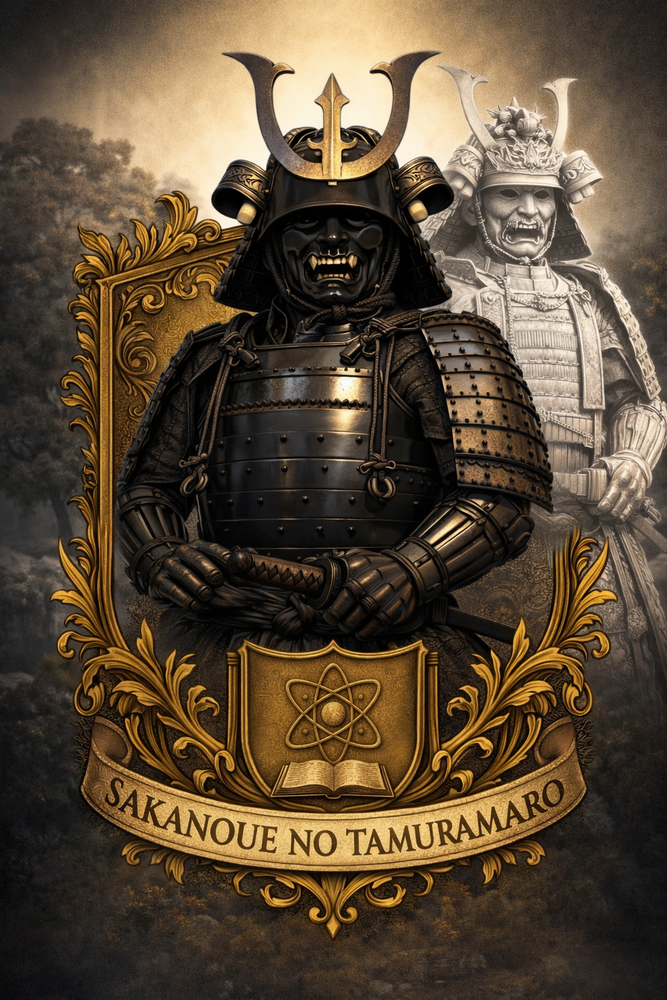
SAKANOŪE NO TAMURAMARO
SAKANOŪE NO TAMURAMARO
Imperial Authority, Frontier Power, and the Original Architecture of the Shogunate
Institute of Black Nobility (IoBN)
Office of Historical Intelligence & Lineage Studies
This article examines the life, authority, and enduring significance of Sakanoūe no Tamuramaro (c. 758–811 CE), one of the most consequential military figures in early Japanese history.
Appointed Sei-i Taishōgun by the imperial court, Tamuramaro embodied the original synthesis of military command, state governance, and frontier integration. Long before the hereditary shogunates, his career established the structural model upon which later Japanese military rule would rest.
I. Historical Context: Japan Before the Shogunate
In the late Nara and early Heian periods, Japan was not yet a fully consolidated state. Imperial authority radiated from the capital but weakened toward the peripheries-most notably in the northeast, where autonomous populations resisted court control.
This was an age requiring more than ritual sovereignty. It required executive power, disciplined force, and political intelligence. Into this environment emerged Sakanoūe no Tamuramaro.
II. The Title of Command: Sei-i Taishōgun
Tamuramaro’s appointment as Sei-i Taishōgun - “Great General Who Subdues the Barbarians” - marks a decisive moment in Japanese statecraft.
At this stage in history:
a) The title was non-hereditary
b) Authority was personally conferred by the emperor
c) Military command included judicial and administrative power
Tamuramaro was not a warlord acting independently of the throne. He was an imperial instrument of order, exercising delegated sovereignty on the empire’s most volatile frontier.
This distinction is critical: the shogunate did not begin as a rival to the emperor. It began as the emperor’s arm.
III. Frontier Governance and Strategic Restraint
Unlike later romanticised portrayals of conquest, Tamuramaro’s northern campaigns were characterised by measured force and political calculation.
Historical sources suggest that he:
Favoured submission and incorporation over annihilation
Integrated former adversaries into administrative structures
Established permanent fortifications and governance centres
This was not mere warfare-it was state formation.
Tamuramaro demonstrated that authority could be stabilised through discipline and inclusion, a doctrine that would shape Japanese governance for centuries.
IV. The Sakanoūe Lineage and Military Nobility
The Sakanoūe clan belonged to Japan’s early military aristocracy-families whose status derived from service, competence, and proximity to power rather than purely ritual pedigree.
Such lineages were:
Mobile within the imperial system
Frequently deployed to liminal or frontier regions
Trusted with autonomous command
In early Japan, nobility was not merely inherited-it was earned and reaffirmed through duty.
V. Representation, Silence, and Historical Assumption
No contemporary likeness of Sakanoūe no Tamuramaro survives. Later artistic depictions are symbolic, not documentary. This absence has allowed modern historiography to project assumptions backward, often shaped by later periods of cultural isolation.
What is historically defensible is this:
1. Early Japan was part of a connected Afro-Eurasian world
2. Elite mobility across regions was real and documented
3. Diversity existed within ruling and military classes long before later homogenisation
Responsible scholarship does not replace one dogma with another-but it does interrogate inherited narratives.
VI. Institutional Legacy: From Tamuramaro to the Shogunate
Later shogunates-most notably the Tokugawa-did not invent military governance. They inherited a template first realised by Tamuramaro:
Central authority exercised through delegated military command
Frontier pacification followed by civil administration
Military power legitimised by imperial sanction
In institutional terms, Sakanoūe no Tamuramaro stands as the architectural ancestor of Japanese military rule.
VII. IoBN Interpretation: Nobility as Function, Not Myth
For the Institute of Black Nobility, Tamuramaro represents a deeper principle:
Nobility is not defined by spectacle or legend, but by function, discipline, and responsibility.
He exemplifies:
Authority without usurpation
Power exercised in service of order
Command balanced by restraint
These are the qualities that define true noble office, across cultures and epochs.
Conclusion
Sakanoūe no Tamuramaro was the first shogun in all but name. A black man. One of my ancestors.
Before the title became hereditary, ceremonial, or absolute, it was executive, conditional, and imperial. Tamuramaro embodied that original form-military authority wielded not for personal dominion, but for the stabilisation of the realm.
His legacy is not confined to Japanese history. It belongs to the global study of how states are built, frontiers are governed, and power is exercised with legitimacy.
Institute of Black Nobility (IoBN)
Reclaiming History. Restoring Lineage. Advancing Noble Intelligence.